*Near 52L is applicable if last closed price is within 10% range above 52 Lows *Data such as market cap may be estimated and not real-time *Companies selected based on personal selection
This does not imply or suggest a buy or sell recommendation.
I am putting everything aside this noon to blog, taking this as a therapeutic task away from life and work.
We are currently in a unique history of events and majority of them are bad. It may also be good if we look at it as a long-awaited correction.
Today, I will be sharing my investment changes and what I have been doing during these maddening times. The work-from-home schedule has certainly made time pass by faster that we are already now in April. Although time passing fast is nice (especially when we are slogging at work), it also means the current circuit breaker will continue to affect many businesses and the society negatively.
We can never have the best of both worlds?
Investments & Finances
I have underestimated the impact of Covid’19 initially, thinking that it will subside in a while. This is due to the lower fatality rate compared to SARS. However, Covid’19 was so much more contagious than SARS.
Due to my wishful thinking, I have added some counters in early February only to see them dropping further. At the very lows of the market, the paper losses whipped out almost half of all my gains since 2016. Fortunately, these are just paper losses and not realized losses. And here we are, the market has recovered substantially from its lows while uncertainty continues to linger.
Below are the actions I made since my last post. I can say that I am not totally unlucky because I managed to make use of the correction to switch some counters as well as enter some at lower prices. I hope I will not jinx myself by sharing!
-Sold Keppel Pacific Oak Reit near its peak
-Sold Paypal at mediocre paper gains
-The cash in USD returned from Paypal and Keppel Pacific Oak are then used to purchase some Microsoft. I am still not sure if I
will sell Microsoft soon since valuations are not cheap. They will be reporting
their earnings next week on 29th April. Let’s see about that. I expect them to beat earnings again but provide poorer guidance.
-Added some DBS and Koufu shares (could have waited
for lower prices)
-While Singtel regained from its lows, I decided
to divest 1/3 of it and shift it to ST Engineering. I guess this is one
strategy to make use of the low prices to switch to better counters (take a loss
and get into another counter to ride its wave; at the same time reduce my risks
on poorer counters and further diversify the portfolio)
The recent correction really reminds me that I should stick to my beliefs and plans than be controlled by greed. From this lesson, we are reminded that all our gains can be returned to the market in a major bear market. So why not keep more cash and wait for it to happen?
Back to finances, most of us get to save more money working from home. This is because we no longer have daily transportation to work and “expensive” lunches at CBD areas. Since we are able to spend less, the money can be used to buy some necessities while we can save the rest. Nevertheless, staying at home means more electricity and water usage/expenses.
Well-being
Working at home means less movement and more snacking. I have stopped jogging for weeks as the park is getting crowded and weather is getting warm. It definitely feels sinful since I used to exercise 3 times per week in the past and snacked less. I am trying to lift some dumbbells and do some high intensity exercises at home to make it up.
It is also getting stale at home. I have finished most of my entertainments such as the game I bought from the recent PS4 Sales and completed my TV series.
Working at home also means we feel less tired. Thus, it gets harder to fall asleep and we tend to sleep later and wake up later. I am thinking that I must exercise more to make myself more tired.
Work & Skills Upgrade
It is hard to literally work at home at times. We tend to feel lazy or distracted. Interestingly, it is also during these times that we start to cherish our jobs more after witnessing those who had lost their income or even their jobs.
Work from home does grant us more personal time, depending on how you do your work. Other than indulging in more entertainment, I have also made used of this period to take up free e-learning lessons such as finishing up on my Python lessons and getting some free skill certifications. It is my plan to practice my programming skills from time to time to keep in touch.
Job-wise, I may have to jump ship again despite not wanting to. The increment rate at my company is too slow and I am expecting to leave if this year’s increment is not up to my expectation. Due to the current situation, our salary had to be freezed temporarily and this means we do not even get a low increment. This is why I am looking around. However, it is almost impossible to job hop with the current headcount freezes and shortage of jobs out there. Guess I will just have to wait and keep the cash flow coming in for now.
I hope this is not a very long post.
Let’s wish we can all cruise pass this period and witness reduced daily infections so we can get back to our normal daily lives. Hopefully, we can all feel better soon.
-I have recently added a small position in Paypal for fintech exposure. This however may or may not be a short term trade.
-Added small position in Keppel Pacific Oak US Reit late last year, partly to push up portfolio’s dividend yield. W8-BEN has been approved by the firm. So goodbye 30% withholding tax and hello 7% divy!
-Continue holding both Singtel and Cisco. For these, I will see how it goes.
-Most of the companies are hovering above the P/E level of 15, which may hint overvaluation levels.
*Yield percentage does not reflect any overseas dividend withholding tax
I will be updating this chart on my page with any new addition/removal.
Perhaps I should include percentage of warchest as well.
2019 had been good year for US investors!
I have been pretty much missing in action in 2019. A post to end the year may be the least I can do.
Here are some updates to life.
Finances:
Finally surpassed the 100k mark. (including investments)
The savings growth shall remain slow being in the rat race.
Investments:
Portfolio has been quite inactive this year mainly due to fear of high valuations, which also caused me to miss several good opportunities. Well, it happens.
However, I was extremely lucky to get out of Costa Group listed in ASX (buying some at $5.70, averaging down at $4.90 before escaping and selling all at $5+ in April’19). In June’19, it shares traded down to the $3.45 lows. It ended the year at only $2.47. Imagine the pain if I am still holding this!
Nothing else is interesting in terms of monthly transactions. However, I did missed another multi-bagger stock yet again. No point beating myself up but take this as fate.
I have been aiming to let go of Singtel to release the bulk of my portfolio to maneuver around, be it into other companies or loading up on cash levels. This too, will increase my confidence to invest into 1-2 new counters.
Overall, my portfolio has realized around 11% gain in 2019, beating STI’s return of 8% but greatly lacking behind S&P’s return of 31%. Can't complain much with less trades made this year. :)
Job:
I am working in an industry I do not yearn for and believed this is a very common issue in the society. I no longer feel pride working. Yet, it is not easy to switch careers during such cautious times. Job hopping is unhealthy as well, especially getting into jobs you may dislike for a higher paycheck. Many fresh graduates are currently struggling to find permanent jobs out there and having one is really something to cherish.
And how do I feel about my job security?
Let’s be realistic. Unless you work in government careers, in a niche market or are highly skilled in IT skills, job security should be pretty much non-existent given the competitiveness these days.
Making it worse, it is hard to find relevant skills to upgrade on - which employers will take into consideration seriously in their hiring decisions.
So what will you do when you get another $500 skills future credits?
Health:
Physical health has been fine doing gym, sports and jogging on a weekly basis. This too helped kept me sane, giving me temporary positive vibes.
Overthinking and over-worrying does take a toll on our mental alertness, fatigue level and affect our daily motivations. Being once poor, it seems that we are engineered to relate everything to monetary consequences. It is both a good and bad thing. It is nice to think ahead but it makes it hard for us to freely enjoy the things we do due to the guilt of spending. Funny enough, we do feel joy keeping more cash on hand. These are just some individual lifestyle choices I guess.
Ending the post, I hope to share more transaction updates in this new year to come~
As the image shared earlier does not do justice to Tableau's real functions, I decided to also share the readable/interactive file in the below link.
By right, its dashboards are useful for users to use filters the criteria they would like to view. For example, users will be able to select only the years they want the data to show, such as only years 2013 to 2016ORonly the top 3 years by the amount of Net income etc. In this case, users can only pick the Years as filters.
If you like this, I may do the same View on another company upon request if I have the time.
2019 is ending and my portfolio is honestly not performing as well this year.
Not much change has been made since my last update.
This is actually a good sign as I used to do many transactions to take quick profits.
Here are some of my recent actions:
•Initiated small position in Keppel Pacific Oak Reit
•Added more Cisco shares
At work, I have been having fun with Tableau software since finally granted access to it. Users’ license seems to be expensive and naturally, not everyone is entitled to use it.
In case if you are not yet introduced, Tableau is a Business intelligence software useful for creating interactive Dashboards and powerful data visualization.
It is good to have at least something fresh to learn at work and I take it as a mini skill upgrade.
However, actual training may be required to create better charts as seen in Tableau Public.
There are really many interesting analysis out there.
So I did a Tableau Dashboard on Microsoft stock (MSFT) just for fun.
Some notes to consider before we start:
1.Reflected share prices were based on closing prices on the last day of each year. Data is from Macrostrend site.
2.All other measures were retrieved from Morningstar Key Ratios. Basic VBA is then used to run/transpose the data into the required format for Tableau to read.
The same Dashboard below can be easily refreshed to analyse any other listed companies as long as the same data format can be generated from Morningstar.
Let’s run through the analysis.
As they say, "A picture is worth a thousand words" and hence the explanation will be kept short.
Earnings:
As seen above, Microsoft’s revenue has been growing consecutively since 2010 (using 5 year average).
Net income dropped in year 2015, 2016 and 2018. Further investigations can be made to understand what caused these drops.
Stock Valuation:
Perhaps PEG ratio is not suitably useful to measure Microsoft since its PEG has been hovering above 1.0 since 2010- which means it is always overvalued. PEG should be more suitable for faster growing companies.
Formula used for PEG is: [P/E Ratio]/[Rev 5-Year Average Growth]/ 100
Earnings per share (EPS) has been edging up slower than its book value per share.
Reason may be because earnings are not growing as fast as asset acquisitions.
Its P/E is last seen to be below 15 at 14.50 in year 2013.
Investors are awarded with increased dividends yearly. Payout ratio can be set visible when moused over using Tooltip function.
Financial Health:
•MSFT’s current ratio has been stable and above the 2.0 level.
•Debt-to-equity has since been reduced from year 2017. This is a good sign.
•Looking at the bottom area chart, MSFT’s cash flows have been rather healthy.
•Inventory level is not quite applicable here since Microsoft is not a hardware centric company.
Thus, quick ratio is not useful in its context (inventory is found in its formula)
It has been fun creating such views with Tableau. I hope you enjoyed it.
There are certainly more improvements to be made. Feel free to add on if you have any comments.
I wanted to do another analysis on the full STI components based on their P/E ratios but was not able to find a legit online source.
Perhaps P/E ratios have to be calculated by our own?
Today, I am here to share on some of my recent trades.
Singtel has been doing well lately but its P/E is getting on the high side at 18+. All eyes on its Ex-dividend date on 26th July.
•Sold some Singtel shares to finally reduce my exposure. Still holding the bulk of it.
•Traded on UOB, with a 7.4% in profit.
•Traded on Capitaland, with a 10% in profit.
•Traded on Sandfire Resources, with a 6.6% in profit.
As you can see, I am once again on selling mode and keeping cash on hand. About half of my investments are now converted back to cash. The markets have been on range trading mode for months, and the upside seems pretty limited.
Reits are popular in Singapore. And there is nothing wrong owning some of them.
I personally have not held any Reits for a while (mostly due to point 2 & 3 below). This does not mean that I am not currently looking out for them because I see no harm holding a small substantial amount to diversify.
Below are the reasons why I minimize holding Reits:
It is better to have Reits when we have large capital to capitalize on the given yield. 5% yield on $4000 is mediocre but 5% yield on $40,000 is something. In other words, I feel Reits suit the rich more.
Reits tend to move slow in prices (same for Trusts). Yes, this means they have less speculative movements. However, I am still quite young and able to take more risks by building more cash from price appreciations. Instead of gaining about 5% yield , there are so many better risks-rewards out there to grow our money.
Most of us should know by now, Reits are exempted from taxation as long as they distribute at least 90% of their revenue to shareholders. This explains why their yield are generally attractive. What is expected to happen during down times (declining net profits) in order for Reits to maintain the same payout per share?
Most Reits move with the economy unless we are talking about more defensive Reits like Parkway Life. If we really want to go long term in Reits, I feel it will be worth waiting for the next cyclical downturn.
Most Reits are heavily in debt and some even have debts higher than 40% of their net worth.
In my own opinion, anyone thinking to go "All-In" on reits without diversifying should probably think twice.
Once again, I got rid of Alibaba and this time at a small profit. The cash is then used to purchase Broadcom shares.
I have always longed to own a semiconductor company and finally picked up Broadcom.
Coincidentally, Broadcom (Avago) was one of the highest volume customer in my previous job among other tech companies like Dell, AMD, Apple, Keysight etc etc.
Probably a waste not leveraging on my work exposure then?
There has been fears that over 20% of Broadcom’s revenue comes from Apple but they are slowly moving away from their reliance on Apple (despite their already diversified structure).One fine example is the acquisition of CA Technologies, one of USA largest software companies. They also sold off their Wireless Iot business to Cypress Semiconductor, foreseeing the great competition and capex ahead. This will also help push their focus on things that will more likely work.
Another fear is the obvious trade war escalation since a big chunk of their revenue comes from China like many chip companies.
If you did not know yet, Broadcom is actually a shareholder centric company (while Alibaba is client centric). The company is still growing fast and some of their free cash flow are turned into dividends to reward shareholders. Their dividend yield is one of the highest in the chip industry and they also use their cash to buy back a lot of their own shares -which once again benefit investors.
The dividend will act as a buffer to volatility as compared to other chip companies like Nvidia, AMD and Micron. Still, I did rather prefer Broadcom use some of the cash to pay off short-term debts to reduce interest payments.
I was lucky to catch the latest price uptrend despite not catching the recent bottom of around $200.
As Broadcom is a great company and its uptrend still looks intact, I will give it some time to see if it will break out through the next resistance of $270.
Happy profiting.
I realized that I have not updated my 30 year old target after passing this milestone back in 2018.
The update is I did not manage to hit $100k net worth but instead only achieved $75k.
Funny enough, I am not upset about the miss. I have tried my best since becoming aware of things.
With time lost, there is only more pushing to be done in the upcoming years.
I just have more rebalancing to do in life to reach my long term goals pertaining to net worth.
Rebalancing of Investments
My strongest current dilemma is on how/ when to rebalance my current holdings despite the decent performance in 2018.
With around 75% in Singtel and 25% in Alibaba, these are apparently extreme investment types. One is a stagnant yield play while the other is an exponential growth play with zero dividend insurance.
Singtel belongs to the traditional defensive industry but is it still defensive now?
I have to admit that there is also partial speculation in Alibaba despite the due diligence done. It is highly dependent on the outcome of this trade war.
However, my current main concern is still Singtel. I wished that I owned less Singtel shares which will translate to more cash to diversify into other cheap companies currently available in the market. With that, I can have a good handful of 4 to 5 companies covering 2 to 3 different stock exchanges.
As mentioned in my earlier post, I have arrived in this situation after acquiring Singtel shares from my fiancée. (There is a joke here too, Singtel is the only company which I dare to invest for my family and yet it was a big laggard compared to many of my previous trades)
Selling some Singtel shares now will only lead to some actual losses. The best way which I can think of is to sacrifice some shares using some of the past dividends received to limit such losses.
Nevertheless, it can be fun and challenging for me to figure my way out since I am stuck in such situation. Once more cash is raised from Singtel, the fun shall begin.
The below points are what I look for in companies.
Guess I am a greedy person who look for great Risk-Return Tradeoff while at the same time seeking insurance from dividends lol.
-Healthy companies (for sure)
-Decent future growth
-Relates to future/emerging trends
-Country diversification in terms of revenue/stock markets
-Decent Yield (% dependent on dividend tax), with controlled payout ratio
I used the word “finally” because it was not a particular good year for me.
There are struggles in life as usual, or perhaps what we tend to perceive as problems ourselves.
Overthinking?
We really need to learn to take more deep breathes, stop and admire the big blue sky above us to remind us how small our problems are in this majestic world.
I know 2018 may be a good year to some people and friends out there so it is not all bad.
Today is the first day of 2019, and we hereby confront our successes and failures.
I was awaiting for the closing bell of NYSE yesterday to conclude my paper losses and overall 2018 performance.
Portfolio for the year was very positive until the big drop from September highs. Some of us are lucky enough to have sold some holdings before the correction happened. My prediction is that any companies we are still holding now should be mostly having paper losses. In my case, Singtel is the heaviest bag I am holding. In Stocktwits forum, we call ourselves “Bagholders” when we are holding on a losing stock.
I guess that the trade war will likely strike a deal within these 90 days while a final agreement will take more time. At least, that is what most of us are hoping for. If this holds true, now will probably be the best time to buy more stocks at cheaper valuations and stocks will rally once again after the deal. (especially stocks with major China revenue exposures)
Before I share my portfolio performance for 2018, I need to highlight 2 things as it does significantly affect the outcome:
•During December, I took over all Singtel shares from my fiancée. (since I was the one who suggested her to buy initially and it has already been a year, I feel that it is best I take over ownership and add it to my portfolio)
•As for the Singtel shares under my parents, these are totally excluded from my performance.
Current holdings:
Singtel, Alibaba
2018
Top Winners:
IRobot: 20.14%
Sembcorp Ind: 12.52%
Sanofi ADR: 9.61%
Top Losers:
Oracle: -3.36%
Alibaba: -21.32% (first batch)
Investments portfolio in 2018: (based on current investment amount + deducted commission fees + currency conversions gains/losses + dividends)
Overall Portfolio: • Total Realized + Paper Gain: 2.72%(includes paper losses in current market)
• Overall Realized Gain: 18.36%(excludes returns in current market)
The good news is the portfolio has beaten the market this year as compared to S&P 500 and STI index.
Feel free to judge ;)
Merry Christmas in advance!
Another year is coming to an end now.
It is unsure yet if 2018 will be a better year in terms of the financial markets but life sure is better this year working for a better company compared to 2017. Work life balance sure makes a big difference. Hope it was a better year for many of you too.
To find out if 2018 was a better year to my money, I shall follow up with a final post to summarize my performance and the good lessons learnt.
Associated British Foods was removed from my portfolio recently as the risks in pounds (GBP) became seemingly high due to Brexit uncertainties. I am lucky to get out early at GBP 24.40 at a profit. It is estimated that the pound can drop by 10-25% to the Dollar if agreements fall out (which it most likely will). Thus, I prefer to have my cash back in SGD.
In contradiction to my last post, I have taken back my words and added Alibaba back for the very long-term growth.
The reason of buying back was due to simple reasoning (yet complicated since I did sold all my shares back in October’18).
USA stocks are mostly expensive, which explains why I am turning back to $BABA for growth. Baidu looks good too. (Some popular US stocks discussed in Stocktwits forum are: Amazon, Apple, Nvidia, Facebook , Alphabet, Microsoft and Netflix)
My prior research was probably insufficient to keep me confident in holding on to BABA earlier.
With further digging, I now have more reasons to back me up now on some past concerns:
Accounting practices
Alibaba shares are held by major and reputable institutions such as BlackRock, T.Rowe Price, Vanguard and State Street. Moreover, the SEC are closely watching Alibaba on its reporting figures. Frauds may exist in NYSE but it is at its minimal. Non-GAAP figures may have been used and it can be argued that they are able to reflect more accurately on the operations of a business than standard GAAP.
The reason of having its shares held in Cayman Islands also became more apparent now. As opposed to allegations made, the main reason of doing so was to avoid the PRC regulations that restricts foreigners investing in China companies. Without knowing this, such arrangements once appeared to me as shady.
Of course, risks are still present to foreign investors here.
Valuation
Investments like Baba should not be for the short term. It may take 2-10 years for share prices to reflect the growth coming ahead.
Alibaba has an attractive PEG ratio of around 1.0. Due to expected growth of around 27% in the next 5 years, it helps explain the current share valuations and high P/E.
Forecasted GBP growth in China is still strong while Baba has many untapped market share to penetrate in China, Taiwan and Asia.
It is obvious Alipay is almost everywhere in Chinese retail as it became a trustworthy brand for vendors and consumers alike. Core e-commerce will also continue to feed into revenues while Alibaba “passively” earns from commissions from each transaction made.
Looming Key risks
Examples are RMB devaluation, trade wars affecting China revenues/investors’ perceptions, China country debts, poor investments made in Media industry.
We know Alibaba is not directly affected by US tariffs (due to revenue largely coming from China) but investors are fearful of how China will be affected as a whole.
Cloud computing is still at a net loss despite its exponential growth.
I was lucky enough to be presented with share prices below the one I have sold previously. (so it is similar to not having sold my initial stakes. Such chances do not always appear).
Anyway, my current exposure is not huge to boost about. Time will tell if the small risk is worth it.
With the downside risks presented in the world, I am switching over to the defensive.
It may be a time when doing less is doing more. (time spent on stock search can be minimized due to most companies being somewhat cyclical)
Recent Actions:
-Stopped loss on Alibaba at around USD 144; I would take it that losses are taken from previous profits and admit my mistake of owning an overvalued company (who says bloggers only share on their profits?)
-Took profit on Sandfire Resources as mining industry is partially cyclical
-Added second batch of SSB to build on interest ladder and may continue to do so
-Added back Wilmar. It is defensive but I dislike their high debt levels.
Let's wait for 7 more days to see how the market react to US mid-term election to decide on what to do next.
I am currently halfway through the book: The Millionaire Fastlane.
It is quite interesting and it changed my view on entrepreneurship.
Its philosophy is however the opposite of many other gurus' as it discourages the norm of saving and investing (buy and hold). The reason is that these actions require us to sacrifice many years of our life before we have a chance to become millionaires. And usually, saving comes down to becoming misers and having a mediocre lifestyle.
From the book, there are three types of people in this world:
Sidewalkers: People who lives a day by a day and tries to consume as much income they have and may even go into debt doing so.
Slow laners: Those who work (be it employed or having a business) and uses the market as their income accelerator. When slow laners become millionaires, they are plagued with old age (probably with poor health) and are "nearing death". Though slow laners are better off than sidewalkers, it is risky to lead such life because many things are dependent on Hope.
For our plan to work: We hope to be healthy, we hope the market will be merciful, we hope not to be retrenched. However, hope is not 100% and it is risky to depend on it.
Fast Laners: Those who take high risks in building businesses that produce explosive returns by selling to many or by selling off the business for millions. And for this to work, the business should not require our constant involvement to produce revenue.
These people gets rich when they are young and are producers instead of consumers. Time is on their side as they gained freedom young.
While I am sharing his ideas, it does not mean that I fully agree to all that was mentioned.
Of course, everyone wants to be a Fast Laner but it is not for everyone. One has to quit their job, and success is not guaranteed.
Away from the serious talk, I am finally going for my overseas holidays after almost a year in Singapore.
Traveling is fun but always tiring and a hassle. Understand that most people will need to travel at least twice a year to be suffice but it is really up to individuals. They are also some who can actually bear not traveling for a year or two. Which type are you?
Anyway, it is time to enjoy while I can before the wedding preps and the busy new year ahead.
I have just added Associated British Foods (ABF) from the the FTSE 100 Component into my portfolio. This is the name behind the budget retailer Primark, the Twinings English tea and the famous Ovaltine drink. It is a conglomerate dealing with 5 main business segments: Sugar, agriculture, ingredient, grocery and retail. While I am aware that Brexit decision largely looms and ABF is exposed to its operations in Europe, shares are selling at a compelling price after my due diligence. Over the years, revenues and dividends are rising while debts are well managed.
In any bear case, there are still dividends to collect and I can even add on my stakes. Like Unilever, IFF and Wilmar, it is a known consumer defensive.
In the same week on Friday, I sold ST Engineering and took profit. My action does not imply a guess that it will not continue higher. It may be the right time, or it may be too early.
This brings me to my portfolio update:
Total Investments
Stocks' Distribution
It is funny realizing that I did not invest in any US based companies at the moment while there are a variety of companies from different continents on hand: AU, UK, CN and SG. Alibaba is not considered US based but only US listed. Probably the rationale in my subconsciousness is, US companies are still expensive after the long bull market.
Back to personal life, I have been feeling dreadful about work lately even before reaching the age of 30.
Work means 5 days of repetitive lifestyle, multiplied by about 4 times per month. Spending time with family, gaming and watching TV shows are things I do when freedom is presented.
The stress, boredom, fatigue, politics and work related expenses which we face all adds up to the importance and motivation of getting to our financial freedom.
Sandfire Resources NL (ASX: SFR) is a copper-gold exploration company based in Perth. Listed on the Australian Securities Exchange (ASX) in 2004, Sandfire Resources was later added in the ASX 200 index in 2010 (not to be confused with ASX 100). Their Copper-Gold mine, DeGrussa, has been one of the best finds made in the history of Western Australia and has since been serving Sandfire Resources with good revenues.
The company is being categorized as a Small Core company by Morningstar despite it being one of the largest copper producers in Australia.
Main Projects Australia: DeGrussa Mine , Monty Mine USA: Black Butte Copper Project
Alaska: Zinc VMS project
Bosnia and Herzegovina: Rupice project
Sandfire’s revenue and assets have been steadily rising while net profits are surging at an even faster pace. Cash balances are picking up since year 2016. All these good signs are largely attributed to the long economy growths which favor copper prices.
Source: DBS Vickers
From my research, the management has been reducing their debts yearly and this is great news to the employees and shareholders. (Long term debts fully paid in FY2017) This led to a strong balance sheet where Total Assets stand at more than 4.5 times of Total Liabilities.
Current Ratio is at 3.80 when a measure of minimum 2.0 is suffice to justify a healthy balance sheet.
This indicates that Sandfire will be strong enough to pay off its obligations for a sustainable period of time during poor industry or economy conditions.
It must be emphasized that about 87% of Sandfire's revenue comes from copper, 11% from gold and only 1% is from silver. In my last post, I shared about the characteristics of copper and gold. Cooper prices tend to rise during economy growth while gold prices tend to rise during economy "doom".
Growth
Growth in copper commodity is supported by the rising demand in Electric Vehicles (EV) and its related infrastructures. Moreover, future copper supply is foreseen to fall short to its future demand. When this happens, it places copper producers at a good spot to command higher prices.
Thus, it is not alarming that Sandfire's revenue is expected to grow 11% annually.
Valuations
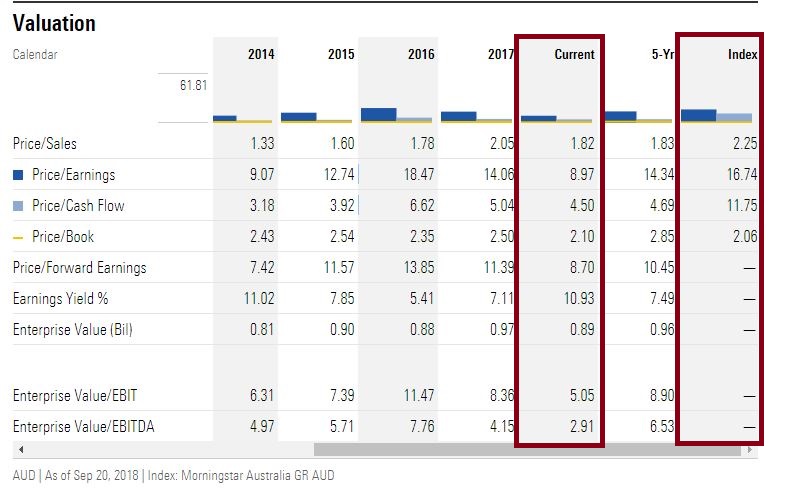
While Sandfire's shares are selling at about 2 times Price to Book Value, this is closely aligned to its industry's index. Looking closer at other measures, its shares are considerably cheaper than its peers in terms of Price to Sales , Price to Earnings and Price to Cash Flow.
It must be reminded that this is not a full apple-to-apple comparison as the 4 companies deal with a different range of metals and commodities.
Dividends
The dividends issued by Sandfire are fully-franked and thus will not be taxed on shareholders. This is also because the company has already paid taxes. "Franked dividends" is a term that prevent double taxing in Australia.
With a dividend of 27 cents per share issued in 2018, this translates to an estimated 4% dividend on the recent share prices.
Risks
Underground mining is an extremely dangerous activity. In each mining accidents or cave collapse, many lives can be lost. This leads to long mining downtime and loss of employees.
Both the company’s reputation and profitability can be instantly and adversely affected if such accidents were to occur.
As Sandfire deals with commodities, revenues can be easily swayed by price fluctuations of Cooper, Gold and Silver. As an example, we had witnessed and are still witnessing how low oil prices have affected the profitability of companies such as Exxon Mobil and Keppel Corp.
With almost 90% revenue coming from cooper, financial position of Sandfire will go on a downward spiral during economy dooms since cooper is an economic indicator.
Its main mine, DeGrussa, is also forecasted to last till year 2022, which is only 4 years away (despite new investments and assets made in other regions as shared earlier) Strengths
-DeGrussa owns one of the world's reportedly largest off-grid solar. Sandfire has been moving its dependence from diesel power to renewable energy by investing in solar systems. With solar energy, Sandfire can save an estimated 5 million litres of diesel per annum. (below video)
-Diversified its portfolio in USA via 78% stake in Black Butte Copper Project
-Rising copper demand along with lack of copper supply sources
-Offers shareholders about 11% hedge from gold (based on revenues)
-Low cost producer, zero long term debt and stable cash flows
-6 years of safe mining operations
To Sum It Up
Sandfire Resources is still growing as a company , has 4% dividend yield, healthy financials and cheaper share price valuations to peers. AUD/SGD is also currently trading at 5 year low of S$0.99, which makes it cheaper for Singapore investors. While there are still risks to consider, my research showed that the pros far outweigh the cons.
I have bought some Sandfire shares before it went ex-dividends on 10th September. (though it is advised to buy shares after ex-dividends)
These are the shares which I hesitated to buy way back in 2017 when it was much cheaper.
Let's see how it goes and I may even add more if it gets cheaper.
Disclaimer:
Writings made in this blog are based on opinions and findings. The writer/author of this blog is not liable on any liabilities or losses that arises from the contents of this blog
Information shared in this blog does not guarantee completeness or accuracy.
Subjects, demographics, currencies, shares or companies mentioned in this blog does not indicate as investment recommendations but solely for discussion and sharing purposes.
I have started to hedge my investments by selling Bumitama Agri to park into the “risk-free yielding” Singapore Saving Bonds (SSB) and getting some exposure to gold.
The thought of hedging came as well after Wall Street reached its longest bull run history. Despite on-going positive GDP growths, unknowns can be dug out anytime and public investors like us will likely be caught off guard. Unless one can be confident that such warnings will be revealed to them in their life or profession before things happen, the overall risk is not really worth it.
The current question in our minds during volatile times must be: should we sell all our investments now and take on lesser pain? (rather than greater pain of major corrections) While there is nothing wrong to do so even at a minor loss, it is not exactly what many will define as “long-term investing”.
Instead of selling, we can turn to hedging. Hedging can come in many forms but it is a double-edge sword. It can either buffer our losses or amplify our pain through deepened losses / opportunity costs (eg. using SSB which has zero price appreciation as compared to stocks).
I am looking at the following hedges:
Gold
Although most gold companies or funds do not pay dividends, it is an obvious hedge tool to many.
Copper is the Boon or Boom measure. Gold is the Doom measure. When it is all gloomy and doom, gold prices will move in the opposite direction of the general market.
Some gold ETFs available are:
Dividend Paying Companies
During down times, dividends are not only bonuses given to us for staying vested.
At the last resort, we can sacrifice our investments using the dividends already realized.
As an example, I am currently losing $500 on each 1000 shares of Singtel.
Till date, I have already received more than $500 worth of dividends from my whole Singtel investment.
If there is really the need to sell partially now, it is a use of realized dividends as a sacrifice.
Another option is to invest in dividend paying companies with some gold exposure. This is hedging in one investment in itself. Some mining companies are:
Pharma or defensive stocks are also "hedges". When the general market is in a correction, we can tell how defensive the pharma companies are from their downside deterrence. Singapore Saving Bonds (SSB)
For risk-free products, we can turn to the popular SSB which rewards us interest every year at “no risks” and with no price fluctuations. I have signed up for October’18 SSB with an average of 2.42% annual interest over the span of 10 years. At this rate, it is higher than most interest yielding deposits out there without the obligation to perform any transactions. The money parked in SSB will be deployed during negative times when the stock market becomes a better alternative.
While tariffs are implemented on China, there has been increased volume of shipments diverted to other ports such as Canada before shipping them to USA to evade them. UK may resort to voting for Brexit. Continual rising interest rates by the Feds. I am not sure if any the events ever reported in the news or something hidden from us will spark the next recession.
My apologies to UN for reading his comments this
late, requesting for more information on this topic.
Micro needling or other facial treatments commonly
costs us around $100 or more in Singapore facial outlets. Some of us may avoid
paying such hefty fees despite hoping to look younger or better. Many are
unware that it is a problem that can be solved by themselves.
When my dermatologist shared that micro needling
is a faster process than most other procedures, it led me to do some further
research. I was astounded to find out that we can easily do it ourselves,
saving us from facial packages. In fact, it is a growing trend and some
celebrities are also having these treatments.
So What is
Micro Needling?
The process consists of rolling many teeny-tiny
needles over your skin, to encourage collagen/elastin production from beneath. This
results in younger, clearer skin and lightening of wrinkles/marks/scars.
One must be able to bear some pain and take
precautions while performing such invasive process.
Micro Needling
Products
We can get the needed products within Singapore. XMedicImports used to have an outlet in Bedok but
is now limited to its sole outlet in Jurong.
Fret not as their products can be mailed to your
doorstep. Delivery costs will appear accordingly on their online platform based
on the products that you picked. If you need further assistance on which
product suits you best, you can contact them via email stated on their site.
For faster response, you can drop an instant message at their Carousell account.
Alcohol
Disinfectant
Derma
Roller
Meso Calm
Solution
Medical
Grade Oxygen
How to perform Facial Micro Needling
1)Cleanse your face and make it dry.
2)Apply Meso Calm on your face to hydrate it.
3)Disinfect your Derma Roller with Alcohol
Disinfectant. Make sure to dry your Derma roller to rid the alcohol before you
start micro needling.
4)There is an effective and correct way of doing
derma rolling. The below video shows us the required directions (up and down,
and diagonally up and down) and how you should hold the derma roller. It is suggested
to roll 20-30 times lightly in each stated direction. Do not use too much
force.
5)Once you have covered the areas you wanted, apply Medical Grade Oxygen and let it rest for 30-60 minutes. Wash your face clean, make sure it is dry and hydrate your skin (Please read up on the products to avoid after micro needling is performed ,before applying anything on your face)
6) Disinfect your derma roller with alcohol after use.
Precautions
To Take:
-Micro Needling is an invasive process and we need
to take good care of our skin while performing it. Any severe damages can be
long lasting or unpleasant to see.
-It is normal for the face to be reddish for
minimum of 1 day, depending on how many times and how much force is applied. It
is also normal to see a bit of blood. Thus, I will recommend one to perform the
procedure on a Friday night and reddishness will be gone by Monday when you go
to work.
-If you have sensitive skin, please check with
your dermatologist if you are suitable for such procedure.
-Tip: It will be good to first try micro needling on
a small part on your skin or your hand to see its effect.
-Let the skin rest 3-4 weeks after each procedure.
This will allow the release of collagen to last longer as well as ensure faster
recovery.
-Do not use facial washes around for 2 weeks after the
procedure. If you need to, please read up on the products which are suitable.
-Important: Ensure sun screen protection 1-2 weeks
after procedure.
For more in-depth guide and research, you may visit the given site specializing on beauty and wellness.
Please do read up more before performing micro needling and take your own needed precautions. Nobody else will be liable as it is your skin after all!
Others: $211.10
-4D and Toto bets: $18
-Household goods: $31
-New work shoes: $87.20
-New shoes for my love: $39.90
-Miscellaneous: $35
(Period: 26th July to 26th August, 2018)
My food and transportation expenses have remained constant as compared to last month's. The betting had been slightly reduced but I think it is not good enough; below $10 will be great.
Overall expenses this month have been jacked up by around $100 due to my 3 years old work shoes finally giving its way ; and when repairing it isn't worth it as it may not last long.
Hesitantly, I got a new shoe from an outlet store at a cheaper offer.
Most of the new expenses in August came from buying things for my girlfriend as I dote on her (more than myself.)
And one can easily say no to themselves but not to their girlfriends, right? lol
I am not sure if annual expenses such as air tickets and hotel charges should also be factored in as well when it is already a minimal one time event.
Though it is fine to stay in Singapore 365 days in a year, I guess it will be healthier for anyone to go out and enjoy different culture and places with our loved ones time to time. Those are the meaningful time which we get to spend with them when our personal time is already so limited. Plus, it keeps our mind sane by being away from the hectic life just for a while.
Thus, it may not be a good idea to include such special expenses to stress ourselves.
Or should we still do it?
Probably, we can use our investment realized earnings or dividends to cover them?
It is a paradox indeed.
Will it be considered working too hard if we factor them in?
Or will it considered cheating when they are omitted?
There are no right or wrong answers.
The market has been restricting much upside gains but it is a good
time to accumulate on the dips. As you guys noticed, I frequently change stocks
to gain on price appreciation and sell them when limited upside is foreseen.
This is my strategy as a young investor to build up capital size. The strategy
will definitely change to a high yielding portfolio as I age to reduce the risk reward ratio.
Sometimes, my exit may be too early which is something I am still
mastering. Like Peter Lynch wrote in his book, “It's easy to make a mistake and
do the opposite, pulling out the flowers and watering the weeds". I
believe my stock picking isn’t shabby but I am guilty of selling stocks too
early at various occasions despite making profits.
Recent Transactions and Dividends:
June 2018
Purchased: LCI Industries, Singtel
Sold: IRobot
Dividends: LCI Industries
-Profited from IRobot with a 20% gain ($80.50 - $67). After which, it
continued to rise another $15 per share.
-Added more LCI Industries
shares to my position.
July
2018
Purchased: UOL
Sold: UOL, Singtel (those bought in
June)
-Earned some pocket money by trading UOL and Singtel (non-contra)
August 2018
Purchased: ST Engineering, Alibaba ADR
Sold: Sanofi ADR, LCI Industries
Dividends: Singtel
Sanofi was sold with a decent 9.6% gain. Finally, Singtel investors received some juicy dividends while taking current paper losses. Singtel is the only stock which
I bought for my parents and my girlfriend to help them better fight inflation. The
recent price drops do give me some concerns mentally but I believe the fundamentals
are intact.
LCI Industries
was trading widely recently and I have to let it go for now with only a 5+% gain. despite some hesitance. It may be a good
thing since it is a pure cyclical stock.
I have also purchased both ST Engineering and Alibaba at near key
support prices using DBS Vickers Cash Upfront. This is my first time using cash upfront on a foreign stock, saving me additional brokerage fees.
Alibaba will be reporting their Q2 2018 results on next Thursday,
23rd August. So please keep a lookout if you are interested. Like many investors, we have great confidence in Jack Ma’s
leadership and Alibaba’s vast business model: Lazada, Alibaba Cloud, TMall, Taobao,
Zto Express, Yahoo China , Ofo Bikes etc. And recently Kroger.
I have updated my portfolio in this blog. While exercising control on my portfolio
size, I will be watching shares of Alphabet, Sanofi, LCI Industries and a UK fast
grower closely to take advantage when price is right.
*Ranking is based on portfolio size
Bumitama Agri will be issuing dividends on 14th
September after reporting fantastic results along with Wilmar recently.
Congrats to investors of both clans and let's await for some dividends.
Before reading the book "Your Money or Your Life", I have been tracking my expenses since the month of May 2018. As the months goes by, the revelations of where my money flows start berthing to the surface. While the steps in the book did instruct us to categorize each of our spending and investigate if they align with our life purposes and values, it may not be necessary for everyone.
Expense tracking apps alone should be suffice for some people, especially those already frugal. In the recent pages read, the book also encourages us to talk to someone or blog about our money journey. This gives us a greater sense of responsibility and accountability.
So here I am.
In July, the new expenses (birthday gifts/treats) under Family category are both non-recurring and well spent. No further efforts on my part to reduce them. It was an overall good month compared to the past. Due to the recent World Cup fever, I did wasted some money on betting in both June and July (along with 4D and Toto).
But like the book says: No Shame, No Blame. Instead, it is a journey of reflection and realization.
To further improve, I have started cutting down on the daily morning $1.50 coffee and switching to Essenso 2-in-1costing only $0.26 per pack lol. (Get a free umbrella when you purchase 2 packs at once)
The weekly bets will also have to be further reduced. The cash will be better utilized on food and transport.
Thanks for reading.
I hope that you are also making your own efforts on the money journey.